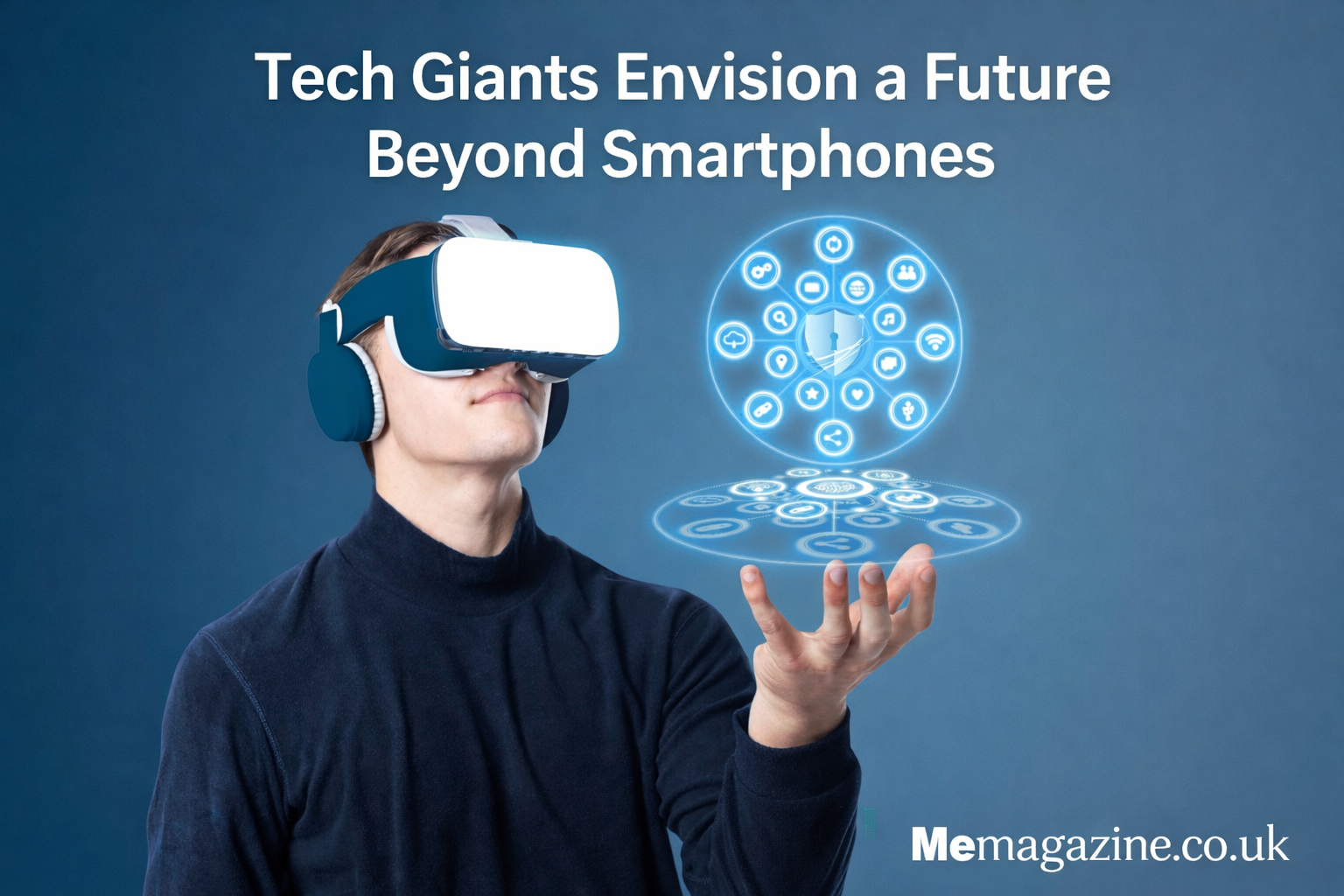
The age of the smartphone transformed global communication and computing. But as hardware advances slow and consumer expectations evolve, major technology companies are forecasting a future beyond smartphones—one powered by intelligent systems, immersive computing, and interconnected environments. From artificial intelligence (AI) that learns your preferences to augmented reality (AR) glasses that overlay digital information onto the physical world, the next technological revolution is no longer science fiction.
Tech giants including Apple, Google, Microsoft, Meta, and others are investing heavily in what could become the post‑smartphone era, with markets expected to reach into the trillions of dollars over the next decade.
This article explores how these innovations will reshape daily life, business operations, and the very definition of what a “personal device” means in the modern world.
The Vision of Tech Giants: What Lies Beyond Smartphones
Smartphones have dominated global technology for over a decade. Yet, innovation trajectories show that companies are shifting attention to technologies that are more context‑aware, seamless, and integrated into daily life. Rather than focusing on incremental hardware upgrades—like slightly better cameras or battery life—tech giants are betting on entirely new platforms.
- Meta: While its Reality Labs division has faced billions in losses (over $70 billion since 2020), Meta remains committed to AR/VR investments, with aims to mainstream smart glasses and immersive environments.
- Apple: Through spatial computing initiatives and developing AR devices, Apple is positioning itself to move beyond flat screens.
- Google: By building Android XR and edge AI infrastructure, Google aims to make connected ambient computing ubiquitous.
- Microsoft: Its emphasis on mixed reality for enterprises and holographic AI showcases a future where digital information blends with physical tasks.
The goal isn’t just new gadgets—it’s making technology seamlessly extend human experience.
Advancements in Augmented Reality (AR) and Virtual Reality (VR)
Augmented reality and virtual reality are at the forefront of the post‑smartphone transition.
AR and VR are no longer solely entertainment tools. AR overlays digital content onto the real world, while VR creates an entirely virtual environment. Both hold transformative potential in education, enterprise, healthcare, and even social interaction.
Enterprise and Collaboration
In professional settings, AR/VR enables remote teams to work in shared virtual spaces, reducing the need for travel and enabling real‑time 3D visual collaboration.
For instance, military contracts such as the U.S. Army’s mixed‑reality headset program, now led by defense firm Anduril, demonstrate how AR systems are being used for situational awareness and operational advantages in complex environments.
Consumer Adoption and Smart Glasses
Recent sales data reflects this shift: in 2025, Meta sold over 7 million units of Ray‑Ban co‑branded smart glasses, more than triple what it sold in previous years—hinting at growing mainstream interest.
Market forecasts also show AR/VR hardware markets rapidly expanding: estimates project over $87 billion in revenue by 2025—and much larger totals by 2030.
Artificial Intelligence (AI) and Machine Learning: Shaping Daily Life
AI and machine learning are no longer niche technologies—they’re the core of the emerging tech landscape.
Smart Assistants and Ambient Intelligence
AI assistants like Google Assistant, Amazon Alexa, and Meta AI are evolving from simple voice commands to ambient intelligence—systems that anticipate needs and interact naturally in the background.
For example:
- Homes may adjust lighting, temperature, and music based on emotional or contextual cues.
- AI algorithms will curate experiences so personalized that traditional interfaces (like tapping a screen) become optional.
Industry Disruption
Across sectors:
- Healthcare: AI diagnostics now aid in reading medical imaging and predicting disease outcomes.
- Finance: Algorithms analyze market trends and provide automated investing insights.
- Education: Adaptive e‑learning systems personalize content pacing and difficulty.
As research predicts that the AI market (including ambient AI services) could reach hundreds of billions by 2030, it’s clear that AI is central to the post‑smartphone future.
The Internet of Things (IoT): Building a Connected World
The Internet of Things (IoT) refers to interconnected devices that communicate data to enhance automation and efficiency. Smartphones were once the control hubs—but IoT is evolving beyond them.
Smart Living
From refrigerators that suggest recipes to health trackers sending data to physicians in real time, IoT is reshaping experiences by integrating devices into a cohesive ecosystem.
In the future:
- Smart cities could optimize traffic patterns, energy usage, and emergency services.
- Agriculture could deploy IoT sensors for soil monitoring and crop health analytics.
- Manufacturing industries use IoT for predictive maintenance, minimizing downtime.
This level of connectivity moves us toward an environment where the device as we know it dissolves into a network of intelligent systems.
Wearable Technology: More Than Just Fitness Trackers
Wearables are rapidly becoming central to the tech ecosystem that may replace or augment smartphones.
Advanced Wearables
Modern wearables now include:
- Smartwatches that monitor heart rate, sleep quality, and stress indicators.
- Smart rings and jewelry providing biometric data discreetly.
- AR glasses that interface directly with our vision.
Companies are pursuing wearables that go beyond notifications and fitness metrics—devices that integrate AI, health monitoring, and interactive display technologies.
Meta, for example, already integrates AI features into its smart backpacks and next‑generation AR eyewear.
Virtual Assistants and Voice‑Controlled Devices
Voice and conversational interfaces are rapidly becoming the way humans interact with machines. Rather than tapping icons, users will speak, gesture, or even use thought‑controlled interfaces.
Voice‑activated systems can:
- Control home systems
- Manage tasks
- Provide real‑time translations
- Anticipate user needs based on context
Virtual assistants are quickly shifting from novelty tools to essential companions in the smart ecosystem—especially as ambient AI evolves.
Emerging Trends in Technology Beyond Smartphones
Several forward‑looking trends suggest how post‑smartphone technologies will evolve.
Holographic and XR Interfaces
Holographic displays and extended reality (XR) technologies are enabling experiences where digital content blends fluidly with physical spaces.
Imagine collaborative design teams manipulating 3D models in mid‑air or virtual classrooms where content surrounds learners.
Brain‑Computer Interfaces (BCIs)
Companies like Neuralink are pioneering interfaces that may one day allow users to interact with machines using thought alone—projected to grow from $2.3 billion in 2024 to nearly $25 billion by 2030.
Though still experimental, BCIs represent the ultimate leap past physical devices.
Societal and Business Implications of Next‑Gen Tech
Technology evolution always has deep social and economic effects.
Work and Jobs
New sectors focused on spatial computing, AI management, and immersive environment design will grow. Traditional roles may shift or even vanish, demanding reskilling and adaptation.
Business Transformation
Companies that embrace AI, IoT, and immersive tech can deliver personalized experiences that increase efficiency and customer engagement. For instance:
- Retailers might use AR to let customers “try on” products virtually.
- Healthcare could offer remote diagnosis powered by AI and sensors.
- Enterprises will deploy mixed reality tools to train and collaborate globally.
Success will depend on responsible implementation, security, and accessibility.
Challenges and Concerns in the Post‑Smartphone Era
No transformation comes without hurdles.
Privacy and Security
As devices collect more personal data and systems become interconnected, safeguarding privacy and building trust will be critical.
Digital Divide
Unequal access to advanced tech risks leaving some populations behind, deepening social and economic gaps.
Environmental Impact
Manufacturing next‑gen hardware, energy consumption, and electronic waste require sustainable solutions.
Human Well‑Being
With technology woven ever closer to daily life, understanding its effects on mental health and human connection becomes vital.
Predictions for the Next Five Years
By 2030:
- AR/VR and ambient AI markets could be worth trillions globally.
- Consumer adoption of smart glasses and interactive wearables will rise dramatically.
- AI assistants will operate proactively, anticipating needs and automating routine tasks.
- IoT will be embedded into environments—from homes to cities—creating truly intelligent spaces.
In short, smartphones may still exist—but they likely won’t be the center of our digital lives.
Conclusion: A Glimpse Into the Future Beyond Smartphones
The post‑smartphone era is more than a technological evolution—it’s a paradigm shift in how we interact with information, environments, and each other. Tech giants aren’t simply chasing novelty; they are restructuring computing itself—from centralized screens to intelligent, ambient systems.
From AR/VR realities and AI companions to holographic interfaces and brain‑computer connections, the future promises devices that understand context, adapt to needs, and integrate seamlessly into daily life.
Understanding and preparing for this future isn’t optional—whether as innovators, businesses, or everyday users, we are standing on the brink of a new digital renaissance.
ALSO READ : Tumbon Explained: Meaning, Uses, Types, Benefits, and Modern Applications